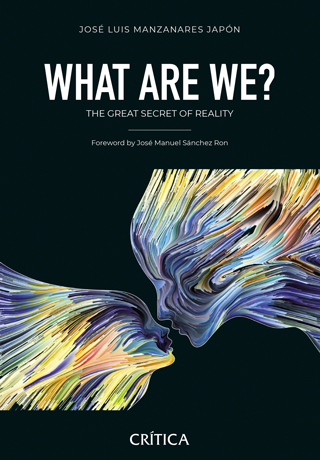
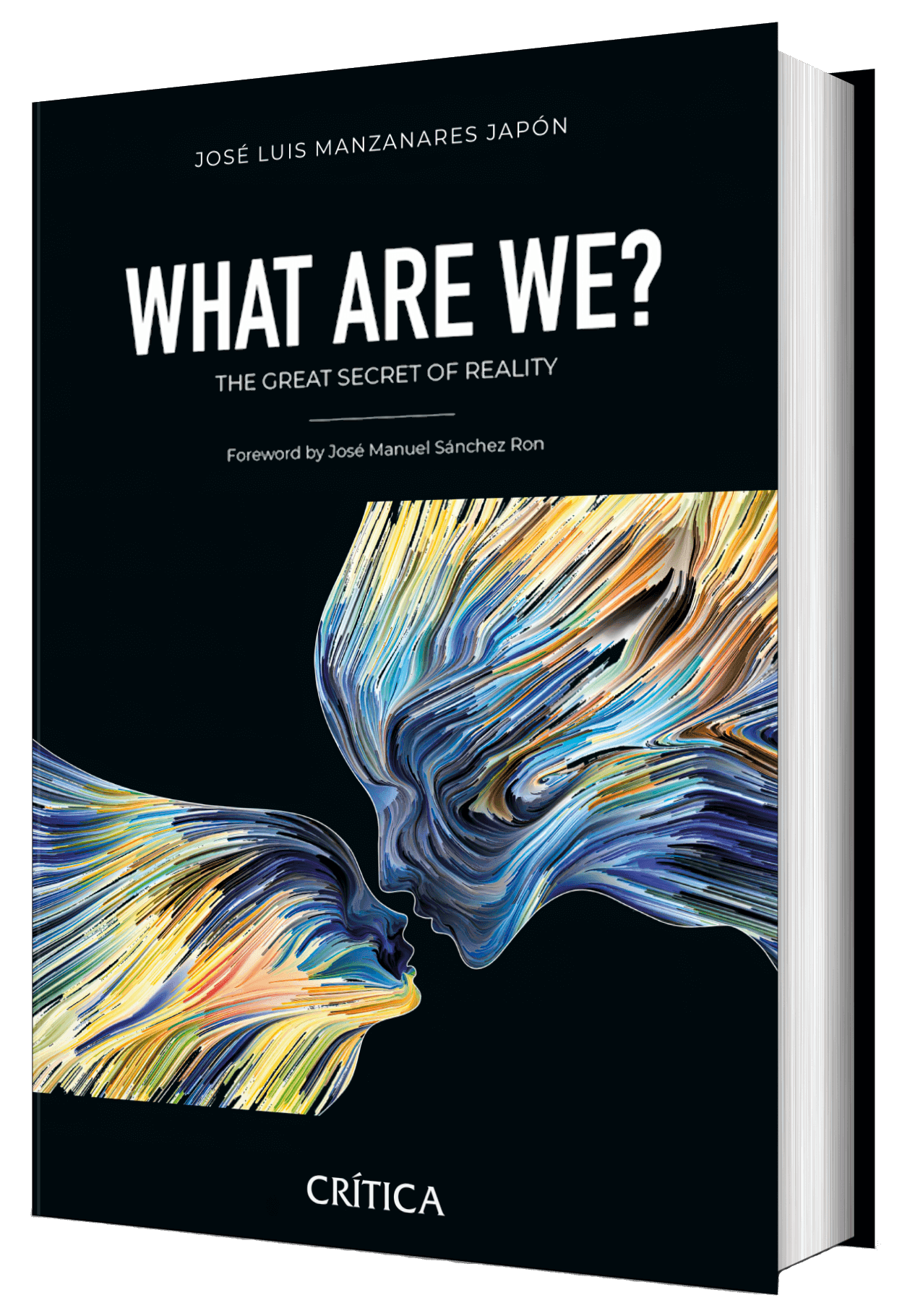
What Are We?


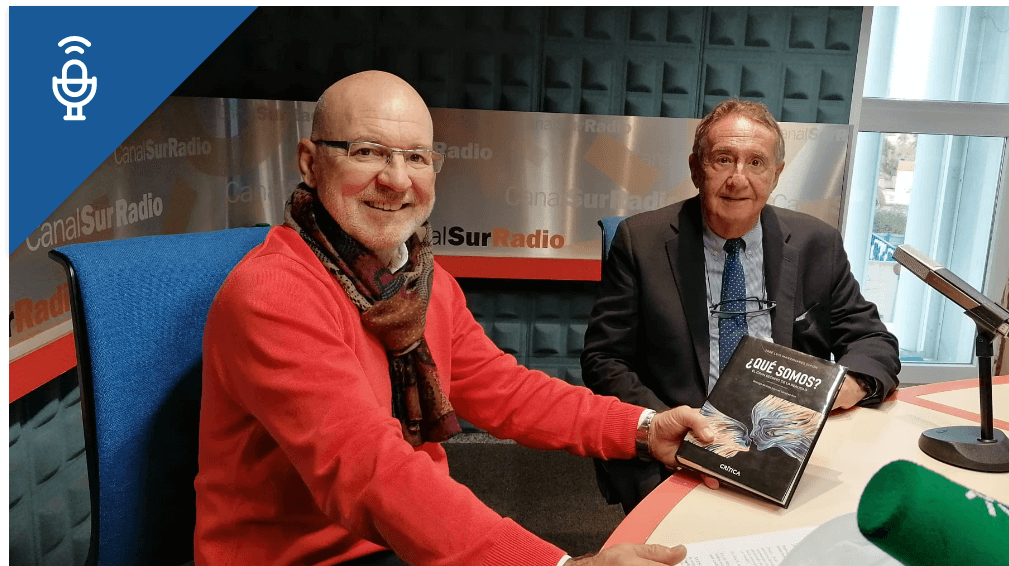
Is an ambitious, disruptive book. A book which attempts to provide a solution to the uncertainties of physics and explain nature. A book which opens a window to the soul.
Existence is guided by a set of mathematical equations or laws that must be obeyed by nature. However, nobody really knows why. Nobody has ever explained to us what reality is, or what the soul is or where is resides.
Find out moreDo we understand the true nature of reality? Does anybody really know what energy and the soul are, or how our mind works?
Did you know that everything is built using just three types of particles, and that matter is nothing but neutrons, protons and electrons surrounded by a vacuum?

Why do we feel butterflies in our stomach when we kiss lips made up of nothing but trillions of intangible particles vibrating and orbiting?
Which law of physics governs the ambition of a leader responsible for starting a war designed to destroy millions of people?

Is love a chemical reaction similar to the acid in our stomach or the process responsible for reconfiguring our protons to make us fat or age?

Why can we not create life in a laboratory? Why is death inevitable?
Where did the energy for the Big Bang come from? Do light and sound really exist or are they mere illusions? What causes gravity?

Although we perceive nature as being material, it is also made up of millions of souls and immensely powerful abstract entitles, such as mathematics, software, religion and politics.
Atoms come together to form matter of increasing complexity—molecules, cells, tissue and living beings— each built using the ones that come before. Each sum is more diverse and has properties that are greater than its constituent parts.
Creation is dynamic and is constantly changing, driven by the laws of physics. However, these do not operate in isolation and need catalysts.
In nature, there are universal algorithmic rules which induce change to drive new species, hostile environments, natural selection and the survival of species.

Physics offers no explanation as to the foundations of nature.
Here, the soul is simply a series of non-specific chemical reactions in the brain, and evolution a process generated by the electromagnetism of the basic building blocks of the universe.
The structure of matter is overlooked by quantum mechanics.
— Using nothing but three types of particles—electrons, protons and neutrons—around a hundred atomic configurations are formed, as well as millions of types of molecules, billions of cells and trillions of living beings, all more powerful than their constituent parts.
— Does it make sense that, according to this progression, a lower level of dozens of different smaller constituents with unique properties is needed to create the three types of atomic particles?

The reductionist approach of physics does not explain reality.
— It fails to take into account the way creation manifests itself and its mechanisms. Where does the instinct to reproduce come from?
— It focuses exclusively on the material world, when in fact reality is host to other equally important entitles and processes.
— It has formulated the mathematical equations that govern certain laws, but has not discovered many of the mechanisms behind them.
— It is unable to explain the nature of the main physical agents, such as mass, energy and electromagnetic waves.
— Nor does it know why information travels at a speed faster than light.
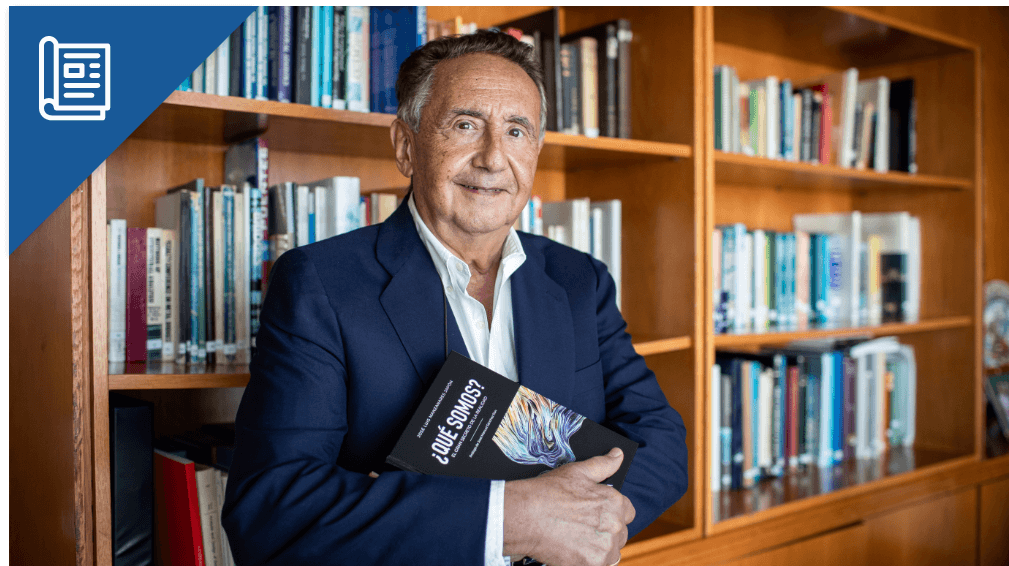
José Luis is an engineer, professor of architecture, an academician of the Royal Academy of Science of Seville and an academician of the Academy of Social Sciences and the Environment of Andalusia. His teaching and research career is truly impressive, and includes numerous scientific and technical publications, as well as short stories, essays and novels. A passionate designer, he has always felt the need to create, leave his mark on the landscape and serve society by helping build a more pleasant and sustainable world.

2023

2014

2014
-

2012

-

-

-

2001

1999

1998

1997
1996

1996
1995